Learning Outcomes
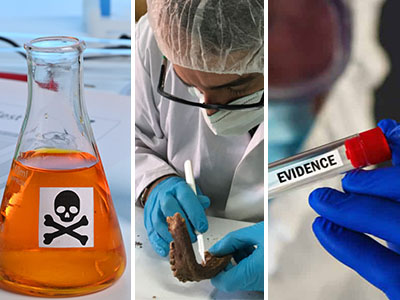
The aim of the course is twofold. The first part of the course aims to familiarize students with basic concepts of Toxicology, such as the metabolism of xenobiotic compounds, as well as with applications of molecular biology in Toxicology, such as the use of flow cytometry and ‘omics’ methods for determining the toxicity of substances, and assays in prokaryotic and eukaryotic cells for detecting substances with mutagenic activity. Additionally, students will be trained in searching for information regarding the toxic action of substances and their mechanisms of action in online databases.
In the second part of the course, molecular biology methods used in forensic genetics and archaeogenetics are presented.
Upon completion of the course, students are expected:
- to be introduced to important concepts of toxicology, such as the metabolism of xenobiotic compounds.
- to become familiar with applications of flow cytometry in determining the toxic action of substances.
- to become familiar with the applications of ‘omics’ methods for assessing the toxicity of chemical compounds.
- to know how to search for and collect information on toxic compounds using online databases.
- to know the genetic methods used in forensic science for solving criminal cases.
- to become familiar with the methodology for extracting and analyzing DNA from fossilized and ancient samples, as used in archaeogenetics.
Course Content
- Metabolism of xenobiotic compounds: The general principles governing the metabolism of toxic compounds by the human body are analyzed, and the main xenobiotic-metabolizing enzymes are presented.
(Assistant Professor Dimitris Stagos) - Applications of flow cytometry in Toxicology: Methods based on flow cytometry for the determination of oxidative stress in eukaryotic cells and the chemopreventive activity against toxic carcinogenic compounds.
(Assistant Professor Dimitris Stagos) - Molecular biology methods for identifying toxic compounds acting through mutagenesis: DNA damage caused by toxic compounds, mechanisms of mutation repair, assays for detecting genetic alterations induced by toxic substances, assays in prokaryotic cells (Ames test), assays in eukaryotic cells (sister chromatid exchange, micronucleus assay, comet assay).
(Assistant Professor Dimitris Stagos) - Information retrieval from toxicological databases with hands-on student training on computers in the DBB Computer Science Laboratory
(Assistant Professor Dimitris Stagos) - Linking exposome with Toxicology: This lecture will present the design of ‘exposome’ studies, cutting-edge methodologies including ‘multi-omics’ technologies, exposome-wide association studies (EWAS), literature examples of exposome research, and how results from exposome studies are translated into personalized prevention strategies against toxic agents.
(Professor Vasilios Vasiliou) - Applications of genetic methods in forensics: Methods for identification and analysis of single-nucleotide polymorphisms (SNPs) and short tandem repeats (STRs) for use in forensic genetics.
(Assistant Professor Ioanna Papathanasiou) - Methodology of archaeogenetic studies: Understanding the methodology for studying the evolutionary history of organisms, serving research needs in archaeology, zooarchaeology, and paleontology; presentation of modern ancient DNA (aDNA) analysis methods, multi-isotope and data approaches, and computational methods to explore issues of population genetics and phylogeography.
(Professor Nikolaos Poulakakis)
Student Evaluation
- Course performance is evaluated based on the individual assignment (30%) and the written examination on the theoretical part of the course during the exam period (70%).
- For students with learning difficulties, a mixed method of assessment is available for all parts of the course.
- The total number of correct answers corresponds to 100 points, which are scaled to a grade out of 10. Based on this scaling, each student’s grade in the theoretical exam of the course is calculated. This grade accounts for 70% of the final course grade.
- A retake opportunity is provided through a three-hour written exam in September.
- Assessment Language: Greek
Assessment Methods: Short Answer Questions, Essay Questions
Recommended Bibliography
- Casarett & Doull, Basic Toxicology, Editor: Parisianos
- Casarett & Doull’s Toxicology: The Basic Science of Poisons (Editor: Curtis D. Klaassen)
- DNA Typing Protocols: Molecular Biology and Forensic Analysis by Bruce Budowle (Editor), Jenifer Smith, Tamyra Moretti, Joseph DiZinno
- Forensic Biology by Richard Li, Ed. Routledge, Taylor & Francis Group
Scientific journals
- Toxicology
- Toxicology Research and Application
- Forensic Science International: Genetics
- Forensic Genomics